What My $200 Codex Plan Was Actually Worth
Seven weeks of Codex logs lined up against my weekly limit, the new Pro tiers, and the 62,500 credits that showed up the night after DevDay: what the pricing change actually means for how I use Codex.
On this page
Tibo’s note sounded contradictory to me.
Right before DevDay, Tibo Sottiaux, a Member of Technical Staff at OpenAI and Codex’s unofficial Reset Czar, posted about the $200 Pro plan reopening to new subscribers. The usage math was changing, and he said it plainly: “it will net out at half the dollar in API spend compared to the old Pro $200 plan.” A paragraph later came the other half: “you will still get more work done than if you were on the Pro $200 subscription one month ago.”
Half the dollars, and more work. Both can only be true if something else moved at the same time. I’ve been on Pro since August 11 and Codex keeps detailed logs, so I went and looked. Then DevDay happened, and then 62,500 credits showed up in my account, so this kept growing.
Where the numbers come from
Codex writes every session to ~/.codex/sessions as JSONL. I had 767 of those files, 4.3 GB of them. After most responses there’s a token_count event, and it carries two things side by side: the tokens that call used, and how much of the weekly limit is gone.
jq -c 'select(.payload.type? == "token_count" and .payload.info != null)
  | [(input_filename | split("/") | last),
     .timestamp,
     .payload.rate_limits.primary.used_percent,
     .payload.info.total_token_usage.input_tokens,
     .payload.info.total_token_usage.cached_input_tokens,
     .payload.info.total_token_usage.output_tokens]' \
  ~/.codex/sessions/2026/0[89]/*/rollout-*.jsonl
The token counts are running totals per session file, so take the change from one event to the next, price it at OpenAI’s list prices, add up the dollars inside each weekly window, and divide by the percent used. That’s what 1% of the limit was worth. Two things to watch if you try it. Cached tokens are already counted inside input tokens, and reasoning tokens are already inside output tokens, so don’t add either one twice. And stick to the running totals rather than the per-call numbers, because some events repeat. I ran it on everything from August 11 to September 28: seven weeks, $8,873 of usage at list price. That leaves out about 36 million tokens on gpt-reserve, a model with no public price.
The exact rules, so the numbers can be checked. Each weekly window runs from seven days before its reset time to the last event logged in it, and its dollars are divided by the highest percent it reached. The logged reset times jitter by a few seconds, so I rounded them to the nearest 10 minutes. I only count windows that reached at least 10%, and only the main codex limit, since some events also report other, separate limits. When a file’s total token count drops, I treat it as a restart and count the new total from zero, and an event that repeats the previous total counts as nothing. When I had GPT-6 Astra redo the whole thing in Codex with its own method, the total matched to the dollar and the weekly-window numbers came out within 3% of mine.
Codex only ran on this Mac, so these logs cover all of my Codex usage. The one thing they can’t see is ChatGPT Work, which draws from the same allowance. Anything there would make the dollars-per-1% numbers below come out low. The August numbers hold steady across six windows, $18.7 to $20.9 per 1%.
I didn’t use staxtrace for any of this, even though these logs are exactly what it indexes. I tried it first. stax compare --provider codex showed $0.00 for every gpt-5.6 and gpt-6 model, which as far as I can tell means its pricing data doesn’t know those models yet. So every number here comes from the raw session files, a few Python scripts, and the jq above.
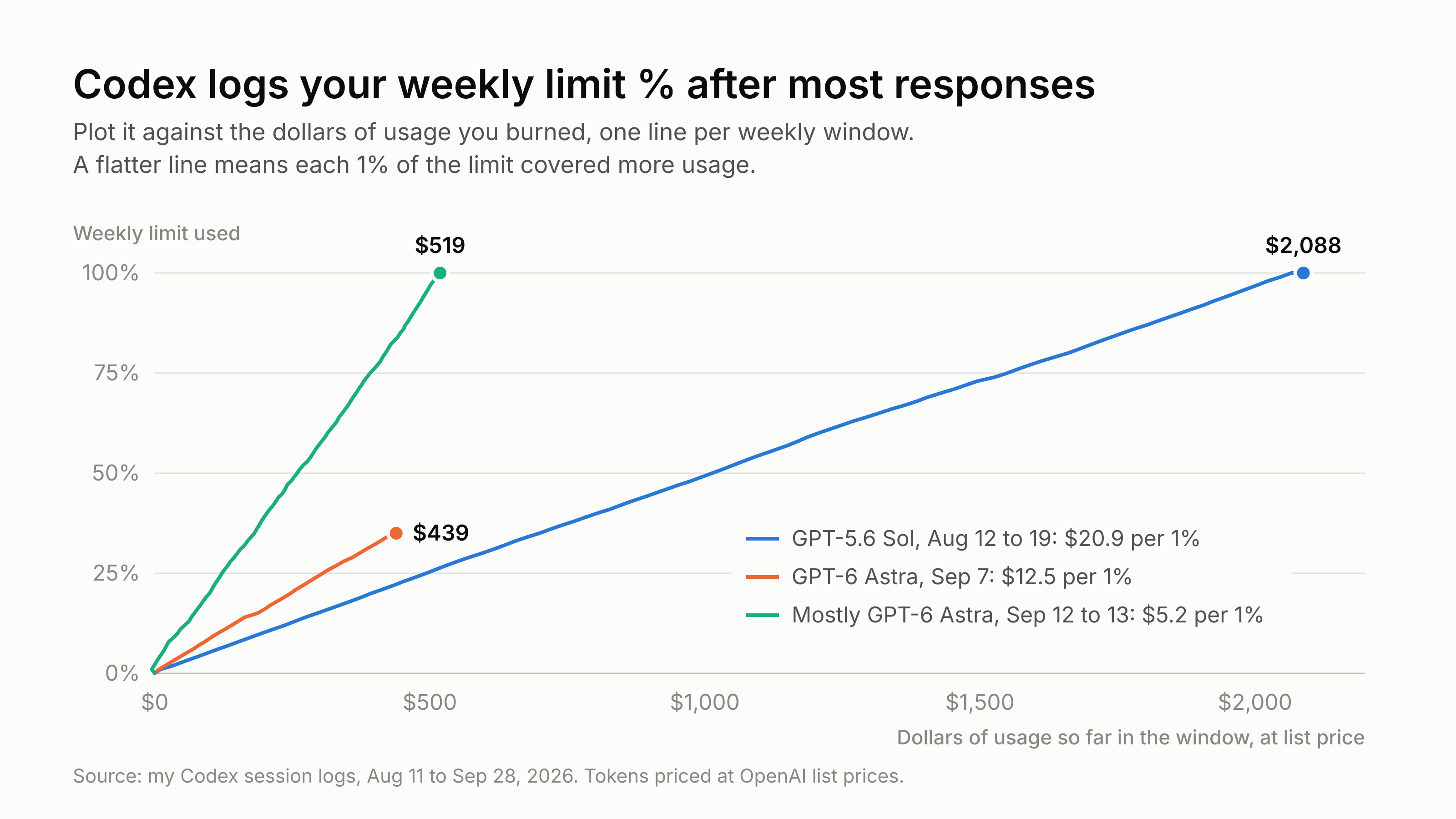
The lines come out nearly straight, so inside a week the limit tracks list-price dollars closely. How steep they are turned out to depend on the model.
The old $200 didn’t have one price
In August I ran almost nothing but GPT-5.6 Sol. A full week covered between $1,868 and $2,088 of usage, with $1,921 in the middle. In September I moved to GPT-6 Astra, and a full week covered about $1,260.
I didn’t expect that. The Codex rate card is list price divided by four cents. Astra costs 250 credits per million input tokens because it lists at $10. But the same page says credit prices alone don’t set how much included usage you get, and in my logs Astra drained the weekly limit about 1.5 times faster per dollar than Sol.
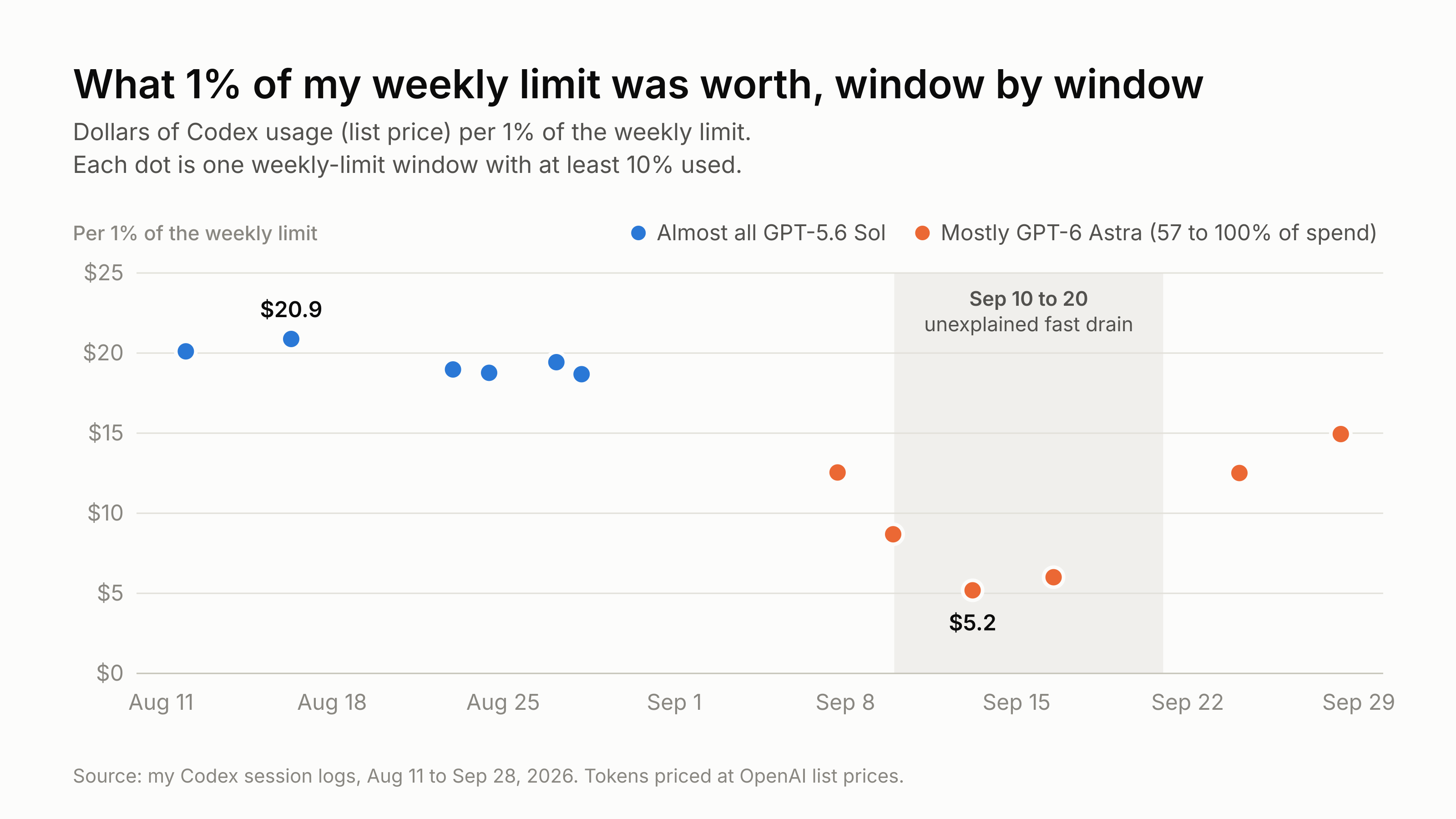
Maybe Astra carries a weight that isn’t on the rate card, or the allowance itself changed when Astra launched. I can’t tell those apart from my logs, and I haven’t found anything OpenAI published that explains it.
Half the dollars, half the price
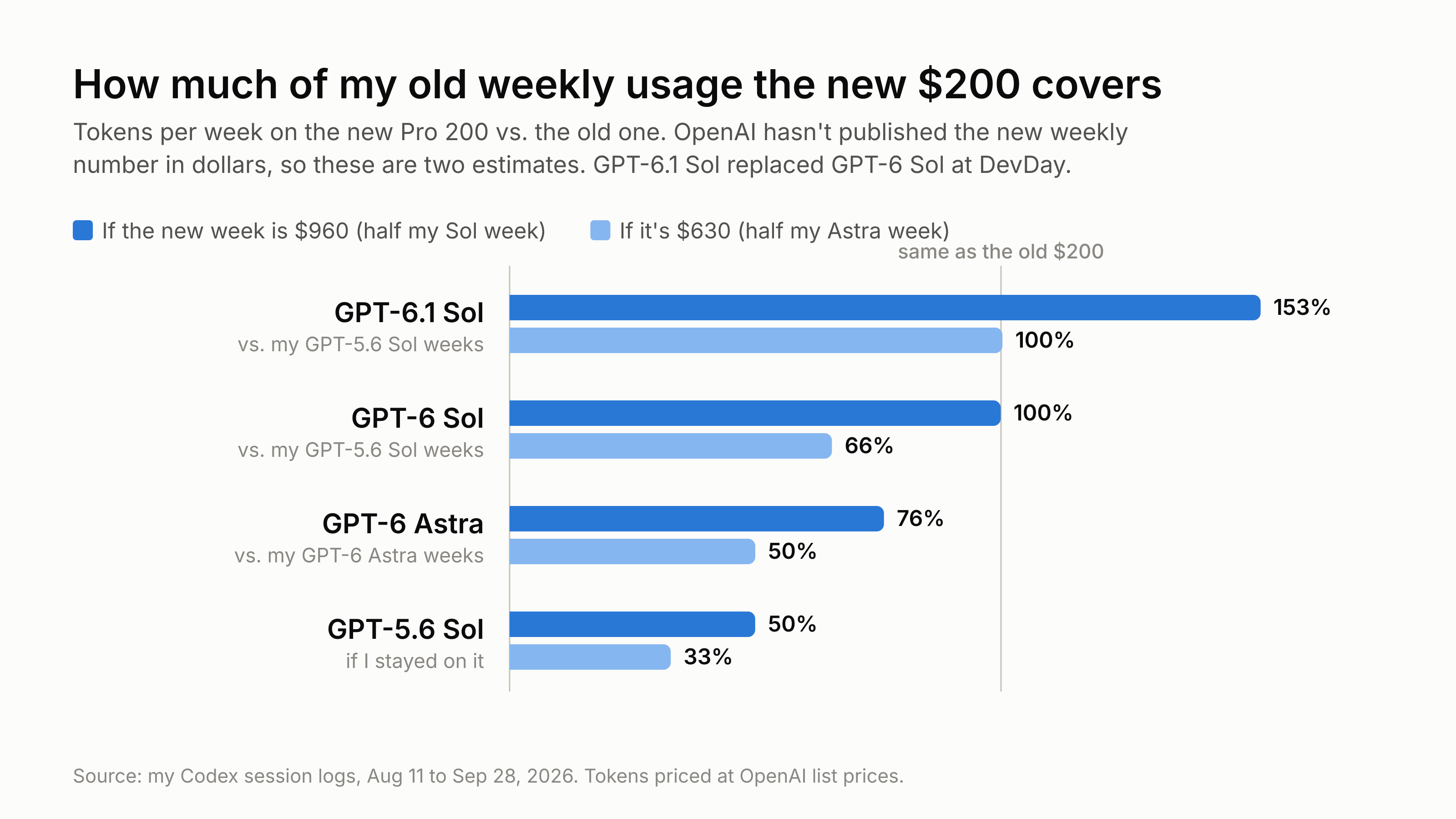
What connects the two sentences is that usage is counted in list-price dollars, and GPT-6 Sol lists at exactly half of GPT-5.6 Sol: $2 per million input tokens and $10 per million output, against $4 and $20. Half the dollars at half the price comes out even. If the new week is $960, half my Sol week, then GPT-6 Sol gets me exactly the tokens I had in August.
Astra didn’t get a price cut, so there’s nothing to even it out. At $960 a week I’d get 76% of my old Astra usage. I also ran it with half my Astra week, $630, since OpenAI never put a dollar figure on the new week. At that number GPT-6 Sol lands at 66% of my August weeks and Astra at 50%. Staying on GPT-5.6 Sol would get me 50% or 33%.
GPT-6 Sol only lasted a week, though. At DevDay, GPT-6.1 Sol replaced it at the same $2 and $10, with cache reads at half the price (Artificial Analysis has the details). Two-thirds of my usage is cache reads, so that matters more than it sounds. On GPT-6.1 Sol, a $960 week gets me 153% of my August Sol weeks, and even $630 gets me 100%. That’s where the more-work part actually shows up for me.
What OpenAI announced
Pro subscribers got an email on DevDay, and someone posted the full text on Hacker News. The line that matters for the $200 plan: “Starting October 30, 2026, your included usage in ChatGPT Work and Codex will decrease from 20 times to 10 times the ChatGPT Plus allowance.” GPT-6 Pro chat goes from 200 messages a week to 100, the price stays the same, and current limits stay until October 29. The email frames it the same way Tibo did: “you can still get more work done with Pro than you could before.”
The same email introduced Pro 500, with “25 times the usage of Plus” and a speed mode called Ultrafast, “up to 8 times faster token generation.” It also added dots, always-on agents that come with every Pro plan, and says “Conversations with your dot and work it does directly are included and don’t draw on your ChatGPT usage allowance.”
Lined up, the tiers are simple:
| Plan | Price | Codex and Work usage | Compared with my old $200 |
|---|---|---|---|
| Plus | $20 | 1x | 5% |
| Pro, $100 | $100 | 5x | 25% |
| Pro 200, through Oct 29 | $200 | 20x | 100% |
| Pro 200, from Oct 30 | $200 | 10x | 50% |
| Pro 500 | $500 | 25x | 125% |
Every tier now gives the same usage per dollar: 5x the Plus allowance for every $100, and Plus itself is 1x for $20. The old $200 was the exception, a bulk discount at twice that rate. A commenter in the Pro 500 thread laid out the same table and called the new scaling equal. Another pointed out that some people were already running several $200 accounts, and one $500 account replaces that juggling.
What the Plus allowance is in absolute terms, OpenAI doesn’t say, and someone in the GPT-6.1 Sol thread noted that the base number was arbitrary to begin with. My logs put my old 20x week at $1,921 of Sol usage, which makes 1x about $96 a week. That’s my inference, not OpenAI’s number, and it’s where my $960 comes from.
Why it changed
The $200 plan had been under strain for a few weeks. On September 9, Tibo warned they might have to pause new Pro subscriptions, and new sign-ups and upgrades to the $200 plan were paused the next day. It read like demand was running ahead of what they could serve.
Tibo’s note also says where the pricing is headed. The subscription gets tied to API list prices, and OpenAI keeps cutting those: “we want to continue to both rapidly reduce prices and increase capabilities of models on the API.” The long-run goal is spelled out too, prices low enough to buy usage as needed “without there being a significant gap between what you get in a subscription and what you get in the API for a dollar spent.”
Reading the threads, a lot of the explanations came back to compute. Heavy users on a flat plan cost more than they pay, and one commenter compared it to flat-rate internet in the late 90s, which didn’t cover its heavy users either. Another read it as OpenAI lining up with the enterprise market, where the people paying the bills have been shopping for cheaper models.
The way I read it: the $200 plan was priced like a bulk discount while demand outran compute, and now every tier costs the same per unit of usage, with the unit pegged to API prices that keep falling. Whether I get more work out of it depends on which model I run, not on the tier.
The 62,500 credits
At 1
in the morning after DevDay, I got an email titled “Your credits are ready.” It said: “We’ve just added 62,500 credits to your ChatGPT Pro account to use across Work and Codex. These credits expire on December 31, 2026.”It’s the transition grant from the announcement, which calls it “a one-time grant of 62,500 usage credits” and puts the value at $2,500 (email text on HN). That matches the rate card at four cents a credit. They show up under Settings > Usage.
I wasn’t the only one wondering what it was. “I have no idea how much 62,500 usage credits are,” one subscriber wrote in the Pro 500 thread, guessing it was about one extra week. By my logs it’s 1.3 of my old weeks, or 2.6 of the new halved ones. Spread over the nine weeks from October 30 to December 31, it takes each week from half my old usage to about 65% of it. In practice the credits only kick in once a week’s included usage runs out. OpenAI’s help page on Pro tiers says included usage goes first, then the credit balance.
The model matters more than the tier
On quality, Artificial Analysis scores GPT-6.1 Sol 1 point below Astra on their Intelligence Index at under a quarter of Astra’s cost per task ($0.72 against $3.26), and notes it uses slightly more output tokens than GPT-6 Sol did.
Re-price my Pro period at GPT-6.1 Sol’s rates and $8,873 becomes $2,394. My Astra usage alone goes from $2,859 to $386. My heaviest weekly window, August 12 to 19, was $2,088 on GPT-5.6 Sol. On GPT-6.1 Sol it’s $677, which is 70% of a $960 week, and every other window comes in lower. But several of my windows reset early. My worst seven straight days, August 11 to 18, come to $1,133 on GPT-6.1 Sol, which is 118% of a $960 week and 180% of a $630 one.
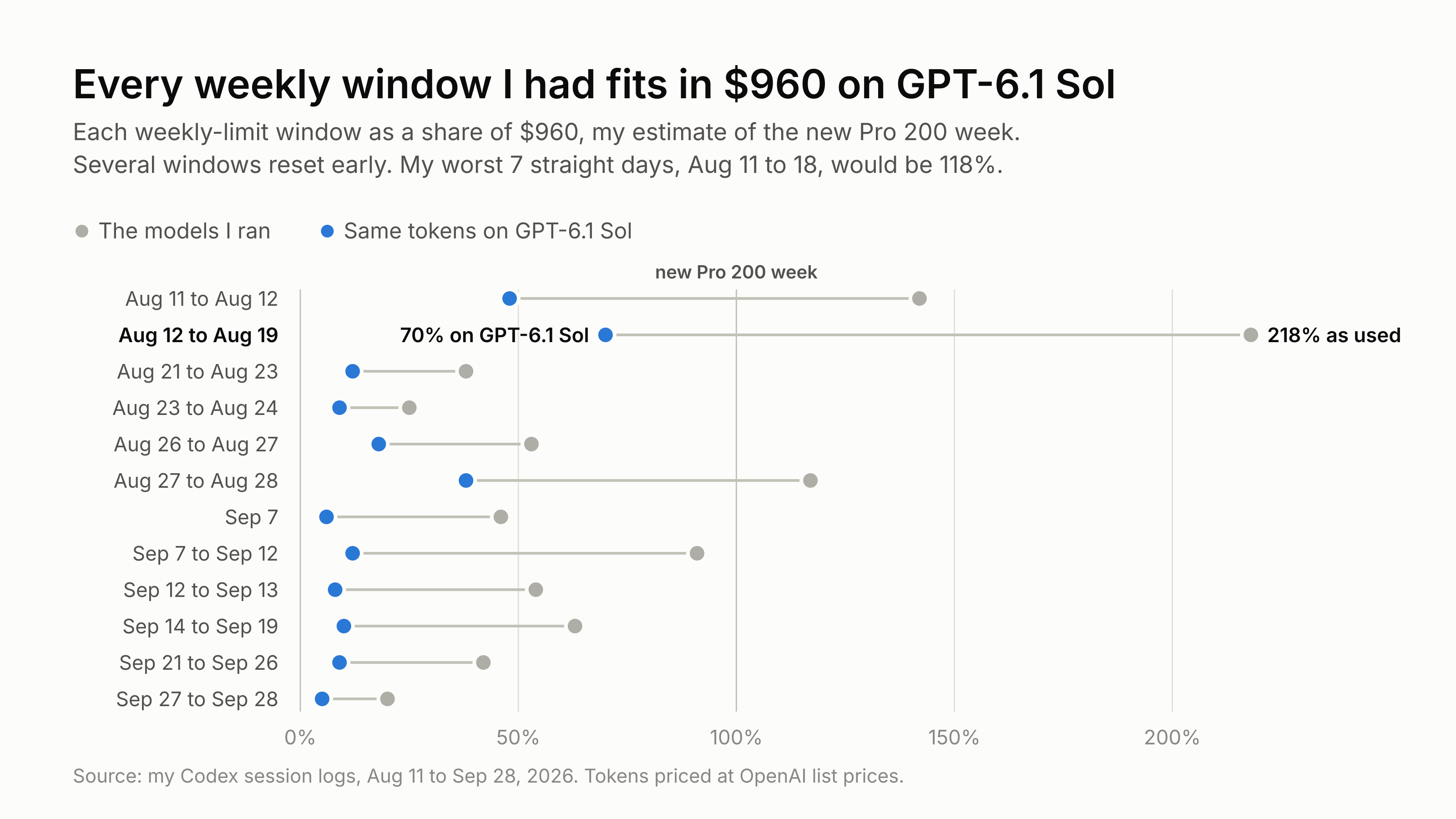
That only works if GPT-6.1 Sol can do my Astra work, and I haven’t tested it yet. A benchmark point isn’t the same as my agents finishing the same tasks. I also can’t run it in Codex yet. When I tried on September 30, Codex answered: “The ‘gpt-6.1-sol’ model is not supported when using Codex with a ChatGPT account.” So for a subscriber, the switch is still hypothetical.
Update, 2026-10-01. GPT-6.1 Sol runs in Codex now. The command that got refused on September 30 worked on my Pro account the next afternoon, and some of my sessions had already been running it since just after midnight. Whether it can do my Astra work is still untested, but at least now I can test it.
Where the usage goes
Cache reads are 67.8% of my usage at list price. That’s the model re-reading context it has already seen, on every call. Fresh input is 20.0%, visible output 7.2%, and reasoning only 5.1%. Forked sub-agent threads account for 57% of the total by themselves.
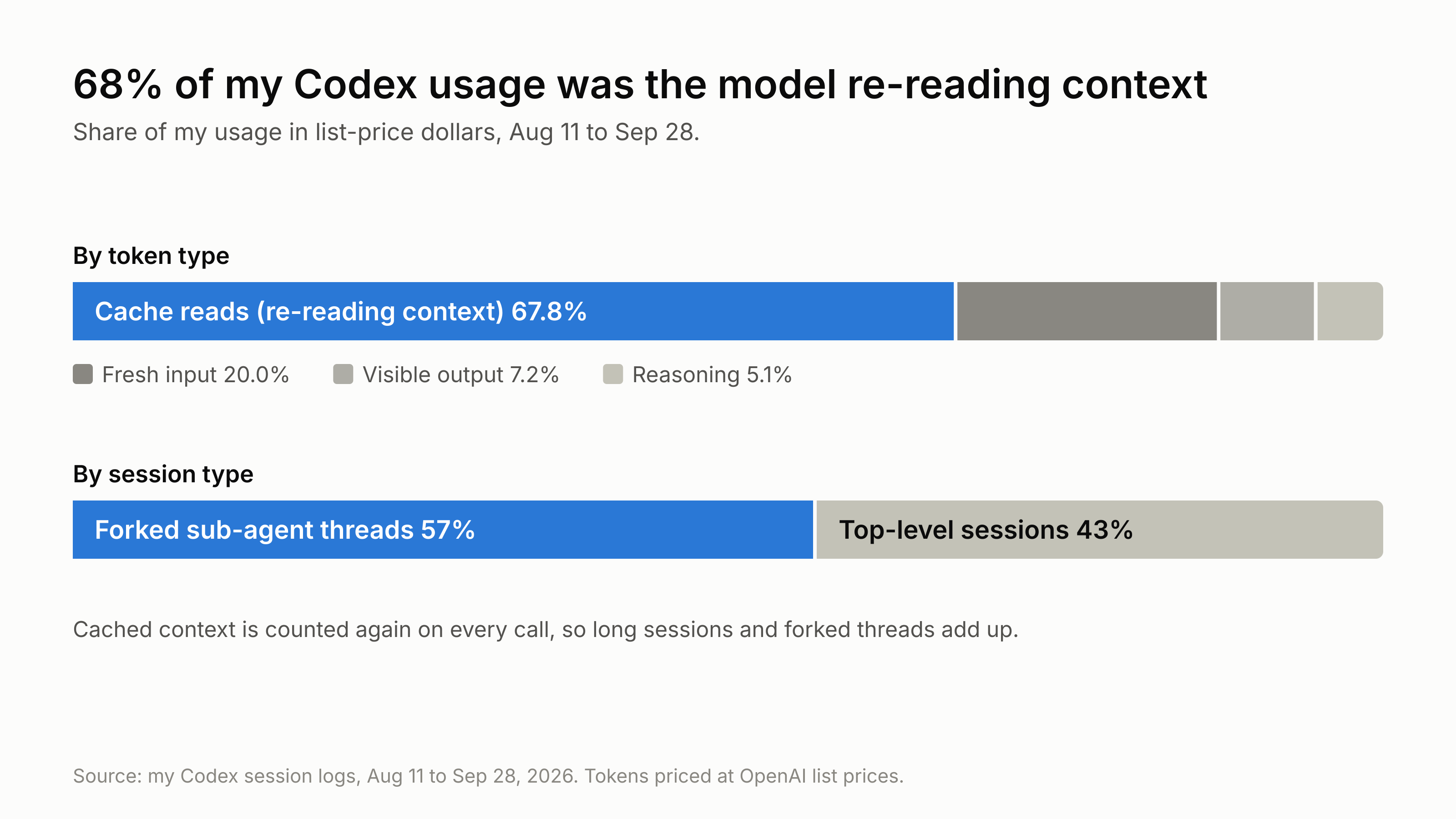
Long sessions and wide sub-agent fleets are what cost. It’s also why GPT-6.1 Sol’s cache price matters more to me than its headline price: $0.10 per million cached tokens, against $1 on Astra. When I read the top comment on HN’s GPT-6.1 Sol thread, it was about the same thing: “This is the actual big announcement. 50% cheaper cache than GPT-6 Sol will get you far more mileage on Codex.”
The stretch I can’t explain
From about September 10 to 20, my limit drained much faster than usual. Astra went from $12.5 of usage per 1% to $5.2, and Sol dropped with it on the little Sol I ran. I hit 100% three times in that stretch. By September 21 it was back to about $12.5.
codexusage.dev logged reports of unexpected quota drain around September 9 to 11, and I haven’t seen OpenAI explain them. The timing lines up with the demand that paused sign-ups, but that’s a guess. It isn’t another machine, since Codex only ran on this Mac. ChatGPT Work shares the allowance and doesn’t show up in these logs, so that’s the one thing I can’t rule out from here.
Terms
- Weekly limit: the percentage Codex reports as
used_percent. On Pro it’s one 7-day window (window_minutes: 10080). My Plus logs from before August also had a 5-hour window. Pro hasn’t had one since I switched, and that’s the limit Tibo said they’re “committing to not reintroducing.” - Window: one 7-day stretch of that limit. Several of mine reset early, including the global reset on September 7.
- List price: OpenAI’s API price per million tokens. GPT-5.6 Sol is $4 in and $20 out, GPT-6 Sol and GPT-6.1 Sol $2 and $10, GPT-6 Astra $10 and $50.
- Cached input: context the model has already seen, charged at a discount every time it’s re-read. $0.40 per million on GPT-5.6 Sol, $1 on Astra, $0.10 on GPT-6.1 Sol.
- Credits: Codex’s internal unit. The published rate card is list price divided by four cents, and the 62,500-credit grant is $2,500 by OpenAI’s own count.
- 1x, 5x, 10x, 25x: how plans are sized now, as multiples of the Plus allowance.
- Forked thread: a sub-agent thread Codex splits off a parent session. Its session metadata has a
forked_from_id.
Where this leaves me
Nothing changes for me until October 29. That’s time to see whether GPT-6.1 Sol, which showed up in Codex for ChatGPT accounts on October 1, can do what I’ve been using Astra for. If it can, Pro 200 covers almost every week I’ve had, and only a stretch like mid-August would go over. If it can’t, Pro 500 gets me 25% more than I had last month. I’ll run the same numbers after October 30, when the new week is real and the logs can say what 1% is worth. Until then I don’t know which of those I’m in.
Links
- OpenAI: Tibo’s post · the Pro email, posted on HN · API pricing · Codex rate card
- Hacker News: Pro 500 · Tibo’s post · GPT-6.1 Sol · the 62,500 credits
- Coverage: Artificial Analysis on GPT-6.1 Sol · The Next Web · Engadget · gHacks · codexusage.dev